

 English
 عربي
 Русский
 Français
 Español
 Deutsch


In heavy commercial operations, communication equipment failure is rarely an isolated inconvenience; it is an immediate safety hazard and an expensive bottleneck. When voice communication breaks down, heavy machinery stops, supply chain flow halts, and emergency coordination becomes nearly impossible.
When procuring professional land mobile radios (LMR), digital mobile radios (DMR), or Push-to-Talk over Cellular (PoC) transceivers, specification sheets are dominated by terms like IP67 and IP68. While most fleet managers understand that higher numbers denote better protection, significant ambiguity remains:
- What exact laboratory testing procedures separate an IP67 rating from an IP68 rating?
- How do manufacturers engineer physical transceivers to resist micro-particulate dust and hydro-static liquid pressure without sacrificing audio loudness?
- Does an IP68 radio guarantee protection against high-temperature washdowns or chemical sea spray?
- How should procurement officers calculate the Total Cost of Ownership (TCO) when choosing between IP67 and IP68 models for their operational fleet?
This comprehensive engineering guide dissects the mechanics of ingress protection, breaks down testing standards, analyzes failure modes, and provides an actionable blueprint for selecting and maintaining waterproof two-way radio fleets.
1. What: Deconstructing the IEC 60529 Ingress Protection Standard
The IP (Ingress Protection) code is an internationally standardized system defined by the International Electrotechnical Commission (IEC 60529), with equivalent national adoptions such as EN 60529 in Europe and ANSI/IEC 60529 in North America. The standard provides an objective, repeatable methodology for classifying the degree of protection provided by electrical enclosures against the intrusion of solid foreign bodies, dust, accidental contact, and moisture.
The Mathematical Anatomy of the IP Code:
An IP rating consists of the two-letter prefix "IP" followed by two mandatory characteristic numerals:
Measures enclosure resistance against physical contact by human body parts, tools, coarse debris, fine sand, and airborne micro-particulates (talcum powder aerosol).
Measures enclosure resistance against vertically falling drops, spraying rain, splashing, powerful water jets, temporary immersion, and continuous deep submersion.
The First Numeral "6": The Meaning of True "Dust-Tight" Sealing
Both IP67 and IP68 transceivers share the maximum achievable solid ingress rating: Level 6. To achieve this certification under IEC 60529 Clause 13.4, the radio is placed inside a specialized dust test chamber containing fine, continuously circulated talcum powder (particle diameter $< 75\,\mu\text{m}$, 2 kg per cubic meter of chamber volume).
Crucially, the test requires Category 1 Enclosure Testing: A vacuum pump is connected to the internal chassis of the radio, maintaining a continuous negative differential pressure of 2 kPa (20 mbar) while drawing up to 80 air volumes through any potential structural seams for a continuous period of 8 hours. To pass Level 6, there must be absolute zero talcum dust deposit inside the housing upon post-test disassembly. For industries such as cement manufacturing, grain elevator handling, open-cast mining, and woodworking mills, this Level 6 dust-tight seal prevents internal insulating bridges and mechanical switch seizure.
The Second Numeral: Comparing Liquid Level "7" vs. Liquid Level "8"
The fundamental divergence between IP67 and IP68 lies entirely in the hydro-static pressure threshold and duration of liquid immersion:
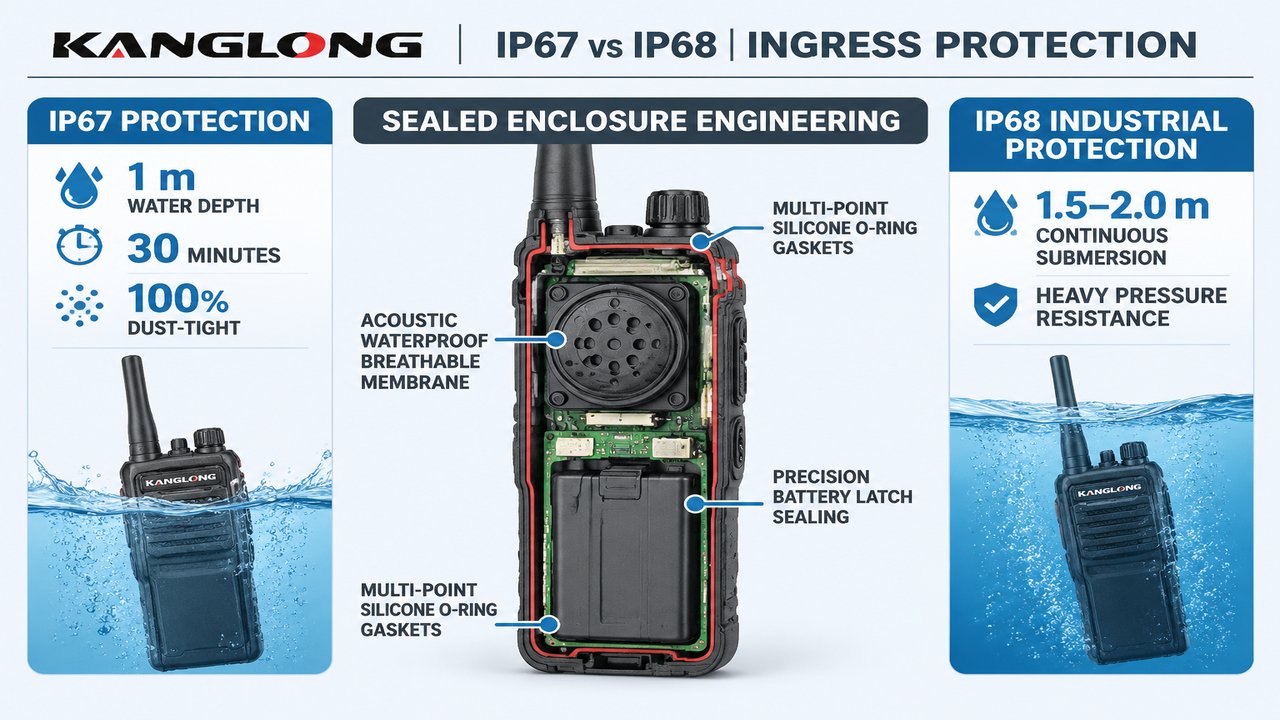
- Liquid Level 7 (Temporary Immersion): The device is immersed in a water tank such that the lowest point of the enclosure is located 1,000 mm (1.0 meter / 3.28 feet) below the water surface, and the highest point is at least 150 mm below the surface. The test lasts for exactly 30 minutes. The water temperature must remain within $5^\circ\text{C}$ of the enclosure temperature to prevent thermal vacuum suction. Passing requires that no harmful quantity of water has entered the enclosure.
- Liquid Level 8 (Continuous Deep Submersion): The test conditions are subject to agreement between the manufacturer and the testing authority, but the standard mandates that conditions must be significantly more severe than Level 7. For industrial two-way radios (such as KANGLONG commercial transceivers), Level 8 typically specifies submersion at a depth of 1.5 meters to 2.0 meters (5 to 6.6 feet) for 1 to 2 continuous hours.
| Rating Code | Solid Protection (1st Digit) | Liquid Protection (2nd Digit) | Test Parameters |
|---|---|---|---|
| IP67 | Level 6: Complete dust-tight seal (8 hrs vacuum test) | Level 7: Protected against short-term immersion | 1.0 m depth, 30 minutes duration |
| IP68 | Level 6: Complete dust-tight seal (8 hrs vacuum test) | Level 8: Protected against continuous submersion | 1.5 m–2.0 m depth, 1–2 hours duration |
2. How: Mechanical Architecture & Engineering of IP67/IP68 Radios
Engineering a handheld two-way radio to survive immersion is vastly more complex than sealing a static smartphone or sensor box. A radio must accommodate moving physical pushbuttons (PTT, emergency orange button, channel selector knobs), high-output acoustic speakers exceeding 90 dB, field-removable high-capacity lithium battery packs, and multi-pin external audio accessory interfaces.
To achieve certified IP67 and IP68 reliability, radio manufacturers employ five core mechanical engineering systems:
1. Continuous Perimeter Silicone & EPDM Compression O-Rings
The mating boundary between the front polycarbonate/ABS housing and the die-cast aluminum internal chassis is lined with a precision-molded, high-resilience fluorosilicone or EPDM gasket. When chassis screws are torqued in a cross-pattern to exact factory specifications, the gasket achieves controlled 25%–30% compression, forming an uninterrupted fluid-tight seal capable of withstanding sustained hydro-static head pressure.
2. Micro-Porous ePTFE Acoustic Breathable Membranes
Speakers and microphone capsules require direct air coupling to transmit sound waves, creating an inherent vulnerability. Engineers protect these openings with acoustic vents made of expanded polytetrafluoroethylene (ePTFE). These membranes feature micro-porous structures with pore diameters of approximately $0.2\,\mu\text{m}$—thousands of times smaller than a liquid water droplet, yet large enough for acoustic sound pressure waves to pass through with minimal decibel attenuation.
3. Internal Atmospheric Pressure Equalization Vents
When an operating radio warms up from internal RF power amplification (PA module generating up to 5W of RF heat) or transitions from an air-conditioned dispatch room to a blistering $45^\circ\text{C}$ outdoor tarmac, internal air expands. Without venting, pressure differentials force air out through weak points; when the radio subsequently cools or touches cold water, an internal vacuum draws water past the seals. Integrated two-way ePTFE pressure equalization vents continuously balance internal and external barometric pressure while maintaining an impermeable barrier to liquids.
4. Dual-Injection Molded PTT & Rotary Switch Bushings
Push-to-Talk buttons endure over 500,000 actuation cycles during a radio's lifespan. Rather than relying on simple adhesive dust covers, professional radios utilize dual-shot thermoplastic polyurethane (TPU) overmolded directly onto the rigid housing, paired with internal silicone dome seals. Rotary volume and channel selector shafts are equipped with internal dual-radial O-rings packed with synthetic grease to prevent lateral water migration during knob rotation.
5. Gold-Plated Compression Battery Terminals & Threaded Accessory Ports
The battery compartment employs an independent perimeter O-ring. Electrical power is transferred via heavy gold-plated, spring-loaded pogo pins that press against gold contact pads on the battery pack under strict latch compression. The multi-pin audio accessory side connector features threaded locking brass inserts and a captive silicone cover gasket to guarantee water tightness whether an external earpiece is connected or disconnected.
3. Why: The Real Industrial Cost of Ingress Protection Failures
Why should commercial enterprises invest in certified IP67 or IP68 radios rather than lower-cost IP54/IP55 consumer-grade models? The answer lies in the harsh physics of real-world industrial failure modes and their downstream financial consequences:
A. Galvanic & Electrolytic Battery Contact Corrosion
When an electrical potential (7.4V DC from a standard lithium-ion battery) exists across metal contacts in the presence of conductive moisture (even slight rainwater or sweat containing mineral salts), rapid electrolytic corrosion occurs. Contact resistance increases from milliohms to tens of ohms within days, causing premature voltage dropouts, false "low battery" alarms, and complete failure during transmission bursts.
B. Acoustic Membrane Saturation & Voice Distortion
On non-submersible radios, liquid entering the speaker grille forms a surface tension meniscus over the paper or thin plastic speaker cone. This adds mass to the driver assembly, severely muffling output audio (reducing speaker output by 15–20 dB) and distorting frequency response precisely when ambient background noise from storms or machinery is at its peak.
C. Internal PCB Micro-Dendrite Short-Circuits
Microscopic moisture entering through an unsealed knob shaft settles on high-density surface-mount circuit boards. Over weeks of thermal cycling, tin-lead and copper migration form conductive microscopic dendrites across fine-pitch digital IC pins, causing intermittent microprocessor crashes, uncommanded frequency hopping, and irreversible mainboard failure.
The TCO Equation: Procurement Cost vs. Operational Halt
Consider the financial calculus: A standard commercial radio fleet might cost $200–$350 per terminal. Opting for an uncertified or low-ingress radio saves approximately $30–$50 per unit upfront. However, in heavy infrastructure, maritime port handling, or oil & gas extraction, the downtime cost of a stalled crane crew or drilling shift easily exceeds $5,000 to $25,000 per hour. Investing in ruggedized IP67/IP68 hardware delivers an immediate return on investment by preventing costly operational disruptions.
4. How: Application Matching Matrix (Choosing IP67 vs. IP68)
Not every deployment requires extreme IP68 continuous deep submersion capabilities. Selecting the right standard ensures optimal fleet reliability without over-allocating capital expenditure. Use the decision framework below to evaluate your target application:
| Rating Tier | Target Operating Environments | Primary Ingress Hazards |
|---|---|---|
| IP67 (1m / 30 mins) |
|
Frequent exposure to heavy rainfall, accidental drops into shallow puddles, wet mud splashes, and high ambient dust blowing from open yards. |
| IP68 (1.5m–2m / 1–2 hrs) |
|
Prolonged submersion in deep muddy water, high-pressure wave spray, corrosive saltwater mist, and continuous high-humidity subterranean condensation. |
5. Field Maintenance Protocols to Preserve Factory Ingress Ratings
An IP rating is not an immortal physical property; it reflects factory-fresh sealing integrity. In the field, physical drops, UV radiation exposure, chemical lubricants, and improper user habits can degrade silicone gaskets over time. To ensure your radio fleet retains its certified IP67/IP68 rating over years of service, implement the following four standard operating procedures:
Whenever an external speaker-microphone or covert acoustic earpiece is removed, ensure the side accessory connector's protective rubber cover is securely fastened and its retention screw hand-tightened. Verify that the battery release latch clicks firmly into its dual-detent locked position.
If radios are exposed to saltwater, brackish tidal water, chemical slurries, or concrete dust, rinse the sealed unit under a gentle stream of clean, lukewarm tap water. Never use high-pressure industrial pressure washers or chemical solvents. Dry with a clean microfiber cloth and allow acoustic ports to air-dry naturally.
When swapping battery packs on job sites, inspect the perimeter silicone O-ring for embedded sand grains, lint, or metal filings. A single grain of quartz sand trapped across the O-ring channel creates a microscopic breach that compromises the water barrier under pressure.
During annual fleet preventative maintenance, authorized service depots should place radios inside an airtight automated pressure-decay chamber. By applying a controlled 20 kPa vacuum or positive air pressure and monitoring decay curves over 60 seconds, technicians can verify micro-gasket health without wet immersion.